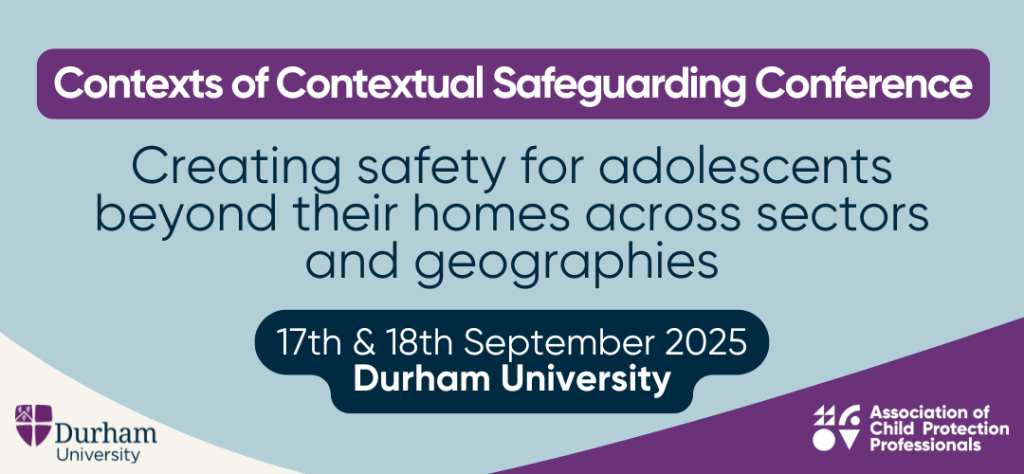

"In September 2025 we will launch the Global Centre for Contextual Safeguarding, ten years on from me first coining the term. We will mark this occasion by holding the first ever international conference on Contextual Safeguarding in partnership with the AOCPP, bringing together those from around the world who have brought the concept to life. The next leg of the road to Contextual Safeguarding starts on the 17th September – and we can’t wait to see you there."
Professor Carlene Firmin, Head of Contextual Safeguarding, Durham University
Wednesday 17 September 2025, 9:30am - 5:30pm, followed by Conference Dinner
Thursday 18 September 2025, 9:20am - 3:30pm.
Durham University, Teaching & Learning Centre, South Road, Durham, DH1 3LS
| Time | Session |
| 9:30 – 10:30 | Arrivals, registrations, coffees and networking |
| 10:30 – 10:50 | Welcome from Durham University & The AoCPP - Launch of the Global Centre for Contextual Safeguarding - Dr Sam Warner, AoCPP - Prof. Carlene Firmin, Durham University |
| 10:50 – 11:20 | Contextual or Conditional? The issue of structural harm Jahnine Davis, Kinship Ambassador and Founder of Listen Up |
| 11:20 – 12:20 | Contextual Safeguarding in Education This plenary session will explore progress made in implementing Contextual Safeguarding in education systems in different parts of the world, and the work still needed to create contextually safe and inclusive school environments for all. Chaired by Margaret Mulholland, Association of School and College Leaders - Naomi Evans, Everyday Racism - Jimmy Paul, Scottish Violence Reduction Unit - Jane Larsson, Council of International Schools - Prof. Daryl Higgins, Australian Catholic University |
| 12:20 – 12:50 | Lunch |
| 12:55 – 13:25 | Provocation by young people and families Facilitated by Dr Nikki Rutter, Durham University The Young Parents’ Research Group is based in Plymouth and made up of local young parents, their children, professional practitioners in Plymouth children’s services, and researchers from Durham University. We have been working together to surface and understand the inequalities and discrimination faced by young parents. Our aim is to work together to change the systems, culture and attitudes negatively impacting young parents, including addressing the lack of policy and practice provision for professionals working in this area. We are delighted that representatives of the group are attending the conference and bringing their expertise to a wider audience. Tia Tracey (Parent Researcher), Chloe Harris (Parent Researcher) and Rachel McDonough (Plymouth Children’s Service). Jo Petty, Bre and Theviya Loganathan - Become Become is the national charity fighting alongside children and young people for a better care system. 1 in 5 children in care are moved more than 20 miles from home - some as far as 500 miles. Become's Gone Too Far campaign calls for children in care to be kept close to the people and places that matter to them. Bre, a young campaigner and Theviya a care-experienced young campaigner have been helping to shape the campaign alongside Jo Petty, Become's Campaigns and Participation Manager. As a group we’ve highlighted the number of children moved far away, children being moved during critical exam periods, and how distant moves impact safeguarding risks. Bre is studying a diploma in law and Theviya is a psychology student. |
| 13:30 – 14:30 | Parallel Session 1 Oral Papers: - Building contextual safety through relationships - Working with parents and carers - Emergent areas for Contextual Safeguarding Workshops: - Supporting youth (workers) to prevent drug related crime: a workshop based on the findings of three research projects - Looking for Love: Harnessing the protective power of peer relationships when safeguarding children and young people - Doing Real-Life System Change |
| 14:35 – 15:35 | Parallel Session 2 Oral Papers: - Building safety collaboratively - System harms Symposium: - Healing Black Youth: An Intersectional lens upon race and vulnerability Workshops: - Safe Uncertainty: Reimagining Relationships and Sex Education - Common Ground and Street Guardians - Engineering the ‘machine’: exploring barriers and opportunities to working in partnership with parents involved with safeguarding systems |
| 15:35 - 15:55 | Tea & Coffee Break |
| 15:55 – 16:20 | Contextual safeguarding and extra-familial harm: insights from national data Prof. Rick Hood, Kingston University |
| 16:20 – 17:15 | System challenges in creating safety in extra-familial contexts This plenary session will identify key system challenges in implementing Contextual Safeguarding approaches in different national and international contexts, celebrating points of progress and identifying barriers most in need of attention Chaired by Ben Lindsay, Power the Fight - Edgardo Toro Quezada, Pontificia Universidad Católica de Valparaíso - Wendy Ghaffar, Ofsted - Dr Stijn Sieckelinck, University of Applied Sciences of Amsterdam - Nicole Savage, North Lanarkshire Council |
| 17:15 – 17:30 | Closing Address Day 1: Jade Barnett - Power2Prevail |
| 17:30 onwards | Drinks Reception followed by Conference Dinner (Optional) |
| Time | Session |
| 9:20 – 9:30 | Welcome Back - Dr Sam Warner, AoCPP - Chair of the Board of Trustees |
| 9:30 – 9:45 | Opening Address - Naomi Danquah, UNICEF UK - Director, Child Friendly Cities & Communities |
| 9:45 – 10:45 | Reimagining the relationship between care and justice frameworks when responding to extra-familial harm This plenary session will discuss the current role of justice and care frameworks in how responses to extra-familial harm are organised, and will look at how these have been, and will need to be, reimagined in order to implement Contextual Safeguarding approaches Chaired by Prof. Carlene Firmin, Durham University - Aika Stephenson, Just for Kids Law - Rachel Knowles, Centre for Access to Justice, University College London - Laura Tanner, Southampton City Council - Prof. Fiona Dyer, Children and Young People’s Centre for Justice, University of Strathclyde |
| 10:45 – 11:30 | Future directions for Contextual Safeguarding in mental health, transitions and neurodiversity This plenary session will feature reflections on the opportunities to apply, adapt and enhance Contextual Safeguarding in other arenas – considering opportunities for using the approach to develop trauma-informed systems, safeguard young people aged 18-25 and better support young people who ae neurodivergent Chaired by Dr Amy Pearson, Durham University - Prof Anita Franklin, Manchester Metropolitan University - Dr Ron Dodzro, Partisan, Juvenis and Power the Fight - Dez Holmes, Research in Practice |
| 11:30 – 11:50 | Tea & Coffee Break |
| 11:50 – 12:50 | Parallel Session 3 Oral Papers: - From the risk to at risk - Foregrounding 'cultures' to build contextual safety Symposium: - Disablism in the context of contextual safeguarding Workshops: - Creating Safety through Context Pathways and Planning - “It’s not just a sticker in a window” – Developing Community Guardianship for young women |
| 12:50 – 13:35 | Lunch |
| 13:35 – 14:00 | Contextual Safeguarding: the Australian journey Dr Susan Rayment McHugh, University of the Sunshine Coast, Australia |
| 14:00 – 15:00 | Community and Peer Guardianship This plenary session will explore the practical application of Contextual Safeguarding through the development of Community Guardianship, with specific consideration of how services are trying to create safety in hospitality, transport and wider community settings using a welfare-orientated, rather then crime-reduction, lens. Chaired by Luke Billingham, The Open University - Mary Mushi, Railway Children Africa - Chris English, McDonald's UK and Ireland - Oliver Heyen, Kent County Council - Kelly Shannon, Swansea Council |
| 15:00 – 15:20 | Closing Address – Prof Carlene Firmin, Durham University - Director of the GCCS & Head of Contextual Safeguarding |
| 15.20 - 15.30 | Vote of Thanks – Prof. Karen O’Brien, Vice-Chancellor and Warden, Durham University |
Young people experience a range of interpersonal harms. Globally, more than 176,000 homicides of those aged 15–29 each year – more than a third of all homicides (WHO, 2022).
The World Health Organisation estimated that up to one billion children and young people aged 2–17 experienced violence or abuse in 2022. During adolescence a significant proportion of this harm will occur outside of young people’s family, and in a range of spaces: from sports clubs and churches to fast-food outlets and schools.
Although many government responses to child abuse target families and parents, in the UK this is changing. In the last ten years, people and places outside of the family home are also being considered as the target of child protection systems. Between 2014-2021, nearly 250,000 social work assessments occurred due to risk of harm outside of family, including violence, criminal and sexual exploitation in public spaces, and sexual abuse in education. Such harm can relate to the experience young people have interacting with authorities, such as police and social work.
‘Contextual Safeguarding’ is used to reconsider the approach to these situations. Tested first in the UK, then Europe and Africa, it requires social workers and other agencies to:
Contextual Safeguarding acknowledges the situation where harm occurs; centres young people’s humanity and promotes their rights, while prioritising their views and working with them and their family to build safety.
Doing this in systems heavily influenced by individual responsibility and criminal justice frameworks, is a challenge. SO, how do we scale and sustain Contextual Safeguarding approaches?
Pilots in the UK and beyond have tested and developed Contextual Safeguarding. The tests have identified the aspects needed to make Contextual Safeguarding work: specifically, in terms of resources, policy, organisational culture and attitudes towards young people. Outside the UK, testing has identified the effect of differing national policies and systems, and the different approaches those working in other countries may take.
The Contextual Safeguarding conference invites relevant professionals, young people, their families, and communities to share perspectives on the theory and practice of Contextual Safeguarding. Of particular interest are inputs on:
By exploring these three themes, this conference will expand upon how we:
Cancellation Policy
